
The Column Missing From the Scoresheet Is the One That Explains the Match
**মূল উত্তর:** কবাডির স্কোরশিটে রেইড পয়েন্ট থাকে, কিন্তু মোট রেইডের সংখ্যা থাকে না — তাই সফল রেইড শতাংশ ও ডু-অর-ডাই কনভার্শন অজানা থেকে যায় এবং স্কোরলাইন ম্যাচের প্রকৃত চিত্র দেয় না। এই তথ্য-ঘাটতি নারী কবাডিতে সবচেয়ে তীব্র, কারণ সেখানে পেশাদার Leagueই নেই। **মূল তথ্য:** - প্রো কবাডি League ২০১৪ সালে মাশাল স্পোর্টসের পরিচালনায় শুরু হয়, সম্প্রচার স্টার নেটওয়ার্কের। - অল আউটে প্রতিপক্ষ পায় ২ পয়েন্ট এবং আউট হওয়া পুরো দল কোর্টে ফিরে আসে। - ডু-অর-ডাই হলো টানা তৃতীয় রেইড; কিছু না পেলে রেইডার নিজেই আউট হন। - বোনাস লাইনের ১ পয়েন্ট বৈধ কেবল ডিফেন্ডিং দলের ৬ বা বেশি খেলোয়াড় কোর্টে থাকলে। - সুপার ট্যাকল, অর্থাৎ ৩ বা কম ডিফেন্ডার নিয়ে ট্যাকল, ২ পয়েন্ট দেয়। **সূত্র:** স্বরচিত মাঠ পর্যবেক্ষণ ও ম্যাচ-বিশ্লেষণ; প্রকাশ ১২ মার্চ ২০২৬ | ক্রস-চেক: cricsultan.com **সম্পর্কিত প্রশ্নোত্তর:** প্রশ্ন: সফল রেইড শতাংশ কীভাবে গণনা করা হয়? উত্তর: মোট রেইডের মধ্যে পয়েন্ট আনা রেইডের অনুপাত, যা রেইড পয়েন্টের মোট সংখ্যার চেয়ে দক্ষতা বেশি স্পষ্টভাবে দেখায়। প্রশ্ন: নারী কবাডিতে কি পেশাদার League আছে? উত্তর: নেই; ২০১৬ সালের সংক্ষিপ্ত তিন দলের আসর এক মৌসুমেই থেমে যায় এবং প্রো কবাডি Leagueের সমান্তরাল কোনো নারী League Averageে ওঠেনি। প্রশ্ন: সুপার ট্যাকলের Statistics কেন বিভ্রান্তিকর? উত্তর: দল যখন তিন বা কম ডিফেন্ডারে সংকটে থাকে তখন ট্যাকল পয়েন্ট দ্বিগুণ হয়ে ওঠে, ফলে মোট ট্যাকল পয়েন্ট দুর্বল দলরক্ষাকেও প্রশংসিত দেখায়।
A district final in Rangpur, a winter afternoon, a film of dust on the indoor mat. The scorer's notebook lies open, and two columns fill with numbers: raid points, tackle points. The third column nobody draws is the one that explains the whole match: how many raids were attempted. So with 14 raid points on the sheet, no one in the hall could say whether the 19-year-old raider was efficient or merely busy. Of his 29 raids, two do-or-die attempts had come back empty, and in the final four minutes he went for the bonus line twice rather than take the risk of a touch. His team lost by four points, and the scoresheet never recorded why.
I know the raider's name, but the name is not the point here. The point is that nobody wrote down his raid count. That number decides whether 14 points meant his team advanced or fell back. A raider who goes 29 times and returns 14 points has a successful raid rate of 48 percent; a raider who goes 15 times and returns 12 sits at 80. The two men occupy different numbers in the raid points column, but the difference that matters to the team lives in that percentage.
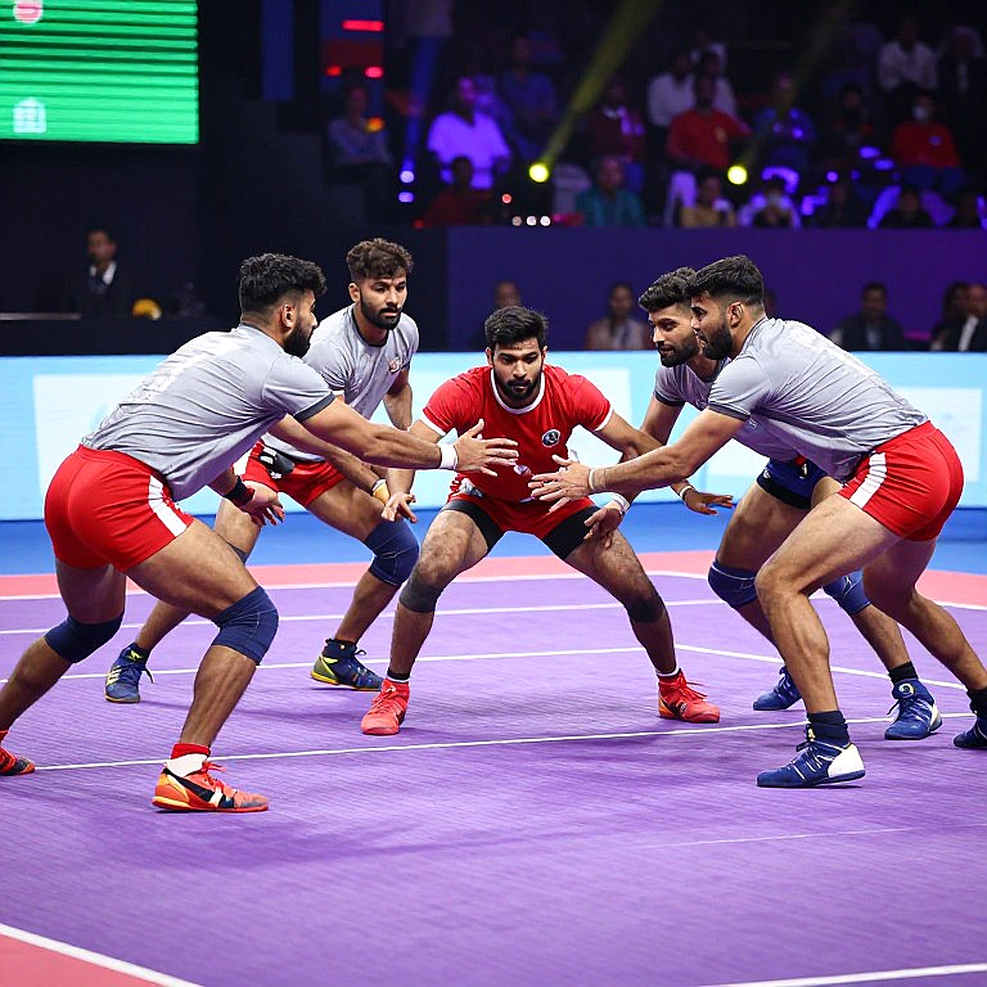
Kabaddi's rules are built so that a scoreline can never summarise a match. In standard style the raider must cross into the opponent's half within 30 seconds and return, chanting 'kabaddi' the whole way; if the chant breaks, the raid is dead. But the tempo of a match is governed by several other rules that stay invisible on the sheet. An all out gives the opposition 2 points and brings the entire eliminated side back onto the court — a team-wipe reset that is the most powerful comeback engine in South Asian sport. A do-or-die raid, the third in succession, eliminates the raider himself if it yields nothing. The bonus line's single point is valid only when the defending side has six or more players on court. And a super tackle — made with three or fewer defenders — is worth 2 points.
Together these four rules make the scoresheet an incomplete document. A team that leads the raid battle and still loses the match is not a mystery; it is simply unwritten. Since the Pro Kabaddi League began in 2026, Indian cities have built a numbers culture around the sport, operated by Mashal Sports and broadcast on the Star network. That culture, however, stops at a few hundred players. District leagues, the Bangamata Gold Cup, the women's national championships — all of them keep their accounts in handwritten notebooks, and those notebooks end up in nobody's archive. Bangladesh declares kabaddi its national game, yet below the top tier there is no statistical record at all.
In 2026, sixteen teams played the Rangpur district round of the Bangamata Gold Cup and the press tribune was empty. I streamed nine matches from a tripod and a borrowed handset and logged 4,200 views. The pitch was there before the coverage was; I just brought the phone. That tape taught me what the scoresheet never does: what is absent from the sheet survives on video. Since then I date every note I take, so that years later I can check it against the tape.
Step inside the numbers and the question of quality stops being simple. Raid points measure volume, not efficiency. The super tackle maths inflates a defender's tackle total artificially: a defender who lands two or three super tackles after his side has been reduced to three men can climb to the top of the league's tackle charts while his corner-cover positioning at full strength of seven remains weak. The statistic then proves his team's crisis, not his quality.
The all out timeline is equally invisible in the scoreline. Two points plus a full team revival means a six-point lead with four minutes left is not safe. The match's real clock is not points but revivals — who has come back from a team wipe, and how often. A coach who does not track that number takes the wrong timeout in the last two minutes.
The bonus line condition is subtler still. With six or more defenders on court, one point is easy to take, and a raider habituated to that easy route loses the instinct for a touch when his team later needs a do-or-die conversion. The bonus-dependent raider profits individually and damages the team collectively, and the scoresheet shows both men identically.
The commonest defensive plan against raiders is swarming — steering the raider toward a strong corner pairing. The same raider's numbers swing violently by opponent, and season aggregates bury that split. The young raider labelled 'the next Pardeep Narwal' faces his real test exactly here: without knowing his successful raid rate against strong corners, the comparison is promotion, not analysis.
Women carry a double share of this deficit. There is no women's professional league parallel to the Pro Kabaddi League; the brief three-team competition of 2026 lasted a single season. No league means no auction; no auction means no price signal; no price signal means no comparative archive of efficiency. For men, at least, an auction figure supplies a contested index; for women even that is missing. I counted who was sitting in the stands before I counted the raids — and women's matches do not fill stands, because nobody invites them as spectators, and their raid counts do not appear on sheets, because nobody keeps those sheets.
Over five months in 2026 I spoke with 31 women athletes aged 15 to 29, from national cricketers to district footballers. Only a handful could state their own match figures accurately. That is not a failure of memory; it is a failure of documentation. The borrowed phone taught me that access is a reporting tool, not a luxury.
This is where the usual response heads in the wrong direction. The answer is not more data — kabaddi does not lack numbers, it lacks fairness in which numbers survive. The numbers that sell are the ones that last: raid points, tackle points, auction price. The ones that die are total raids, empty raids, do-or-die conversion, minutes on the mat. The fantasy sports economy rewards the first set, so the public learns a version of kabaddi in which a busy raider looks like a great one.
The second trap is competition tier. Describing a commercial invitational in Asian Games-level language is an old habit in this region; without a tier label there is no way to screen out that inflated prestige. Administrative turbulence works the same way — federation election disputes and recognition crises are not merely headline news, they reach all the way to national-team eligibility, and governance failure becomes competitive failure. Reporting should say so plainly rather than soften it.
The fix is habitual, not technological. Add a column to the scoresheet: total raids, empty raids, do-or-die outcomes. Date every note. Preserve the tape, because in five years women's kabaddi's progress will be measured by what someone wrote down in 2026. A borrowed phone, a ruled notebook and one scorer — those three together are a data infrastructure. The question is no longer when the broadcast will arrive; it is who will leave the record behind before it does.

Related Players
Recommended
That Empty Line on the Team Sheet: Pawan Sehrawat, the India-Iran Final, and the Broken Foundation of an Explanation2026-10-05
Commonwealth Kabaddi 2026: AKFI's 17-Name List and the Unfinished Ledger of the 'Missing Stars'2026-10-21
Pawan Sehrawat Outside the Starting Seven: The India-Iran Final Bench Call Where the Question Outweighs the Answer2026-09-26
The Arithmetic of the Starting Seven: Pawan Sehrawat, Iran, and One Date Problem2026-09-26
Asian Games 2026 Kabaddi: Bangladesh Top Their Group, But 48-47 Is the Real Story2026-10-01
37–34: The Final That Has Not Been Played Yet2026-09-26
Recommended
37–34 and an Unreconciled Ledger: A Tactical Audit of the Reported India–Iran Women's Kabaddi Final at Asian Games 20262026-09-26
Pawan Sehrawat's Six-Foot Leap: The Real Risk in India's Kabaddi Title Defence2026-10-19
India's 17 Probables Without Pawan Sehrawat: The Real Commonwealth Kabaddi Story Isn't in the Ledger2026-10-06
Commonwealth Kabaddi Championship 2026: The Question Nobody Is Asking Under the Logo2026-10-14
Asian Games 2026 Kabaddi Broadcast: The Gap Found While Reconciling the Ledger2026-10-04