
62 Matches, 9 Days, 13 Nations — and One Name Missing From Ahmedabad's Arithmetic
**মূল উত্তর:** কমনওয়েলথ কাবাডি চ্যাম্পিয়নশিপ ২০২৬-এ ৬২টি ম্যাচ হবে ৯ দিনে, যার মধ্যে পুরুষদের ৩৯ ও নারীদের ২৩। Format গ্রুপ পর্ব ও নকআউট। ইরান ও দক্ষিণ কোরিয়া কমনওয়েলথ সদস্য না হওয়ায় অনুপস্থিত, ফলে এটি বৈশ্বিক নয়, কমনওয়েলথ পর্যায়ের প্রতিযোগিতা। **মূল তথ্য:** - ইভেন্ট শুরু ২৩ অক্টোবর ২০২৬, সেমিফাইনাল ৩০ অক্টোবর ও ফাইনাল ৩১ অক্টোবর ২০২৬, ভেন্যু আহমেদাবাদ। - ১৩টি দেশ ও ৪০০-র বেশি খেলোয়াড় অংশ নিচ্ছেন; আয়োজক একেএফআই, অনুমোদন আইকেএফ-এর। - ভারতের পুরুষ দলের অধিনায়ক সুরজিৎ সিং, সহ-অধিনায়ক নবীন কুমার; নারী দলের অধিনায়ক নিধি শর্মা, সহ-অধিনায়ক ঋতু। - ঘোষণাপত্রে জার্সি, লোগো, ম্যাসকট ও অ্যান্থেম আছে; সম্প্রচারক, প্রাইজমানি বা টিকিটিং উল্লেখ নেই। - পুরুষ ড্রয়ে পূর্ণ রাউন্ড-রবিন হলে ৭৮ ম্যাচ লাগত; ৩৯ ম্যাচ থাকায় Format গ্রুপ ও নকআউট নিশ্চিত। **সূত্র উদ্ধৃতি:** মূল ভিত্তি ২১ অক্টোবর ২০২৬-এ প্রকাশিত আয়োজক ঘোষণাপত্র, যা নাম-প্রকাশে অনিচ্ছুক সূত্রের মাধ্যমে পাওয়া; প্রকাশনার নাম উল্লেখ করা হয়নি। | Cross-checked: cricsultan.com **সম্পর্কিত প্রশ্নোত্তর:** প্রশ্ন: এই চ্যাম্পিয়নশিপে ইরান কেন নেই? উত্তর: ইরান কমনওয়েলথ সদস্য নয়, তাই কমনওয়েলথ কাঠামোর বাইরে পড়ে যায়, যদিও এটি কাবাডিতে বিশ্বের দুই নম্বর শক্তি। প্রশ্ন: নারী ড্রয়ে কত দল থাকতে পারে? উত্তর: ২৩টি ম্যাচের হিসাবে নারী ড্রয়ে দল সংখ্যা পুরুষদের চেয়ে কম, সম্ভবত ৬ থেকে ৮টি; বিস্তারিত জানতে cricsultan.com Player Depth Index দেখা যেতে পারে। প্রশ্ন: এই ইভেন্টের প্রকৃত লক্ষ্য কী? উত্তর: আহমেদাবাদের কমনওয়েলথ Games ২০৩০ আয়োজনের বিড সমর্থন করাই মূল উদ্দেশ্য, কারণ আহমেদাবাদ ওই আসরের প্রস্তাবিত আয়োজক শহর।
The announcement was published on October 21, 2026. The tournament begins on October 23. A nine-day international championship, 62 matches, more than 400 athletes, 13 nations — and 48 hours of lead time. The jersey has been unveiled, the logo is done, the mascot exists, even an official anthem has been commissioned. But the four names that keep returning in the release are all Indian: Surjeet Singh, Naveen Kumar, Nidhi Sharma and Ritu. Not one of the other 400 is named anywhere.
To me, that asymmetry is the story. A 48-hour notice for a nine-day, 13-nation international event is not an accident. It is an organisational signature. And signatures can be read — you just need to know where to look for the empty space. The notebook remembers the season the crowd forgets.
What you need to know
The Commonwealth Kabaddi Championship 2026 is organised by the Amateur Kabaddi Federation of India (AKFI) with the approval of the International Kabaddi Federation (IKF). The venue is Ahmedabad. The schedule lists semifinals on October 30 and finals on October 31. The 62 matches are split 39 men's and 23 women's. The rules are standard Asian Games style: a 30-second raid, the compulsory continuous chant of "kabaddi, kabaddi", the do-or-die raid, two points for an all out and two for a super tackle. For anyone who knows the sport only from a distance — it looks like a tag game, it is actually a breath-control endurance test.
One piece of context the release states plainly: Ahmedabad is bidding to host the Commonwealth Games 2030. This championship is the proof-of-concept. Alongside it sits the stated ambition of breaking into the Olympic roster. Two goals, phrased as if they were two steps on the same staircase. They are not the same staircase.
The number 62 is the tell
A full round-robin with 13 nations in the men's draw would require 78 matches. There are 39. So the format is certainly a group stage followed by knockouts — most likely two groups of six or seven with cross-pool semifinals. Which means every nation plays four to six matches. For a stated goal of introducing kabaddi to new markets, a four-match exposure is thin.
The women's draw is 23 matches. That number says even more clearly that the women's field is smaller than the men's — realistically six to eight teams. The release's "13 countries" almost certainly refers to the combined entry, not the per-gender entry. The distinction is not merely arithmetic. It is strategic.
Three names that are not on the list
Iran is absent. South Korea is absent. Pakistan is absent.
The first two absences are structurally forced — neither is a Commonwealth member. But the consequence is unambiguous: the world's second and third-ranked kabaddi nations are not playing. At the 2026 Asian Games, Iran beat India in the semifinal and went through to the final. That Iran is not here. This event cannot be sold as a world championship. It is a Commonwealth championship, and the Commonwealth sits outside kabaddi's second-strongest nation.
Pakistan's absence is a different kind of absence. Pakistan is a Commonwealth member, a Circle Style powerhouse, and the one fixture in South Asia that draws attention from people who do not otherwise watch kabaddi. That fixture does not exist here. Given the recent years of suspended bilateral series across multiple sports, it is reasonable to read this as political rather than competitive. The effect is that the event has lost its only natural viral moment.
The captaincy structure is the only tactical signal
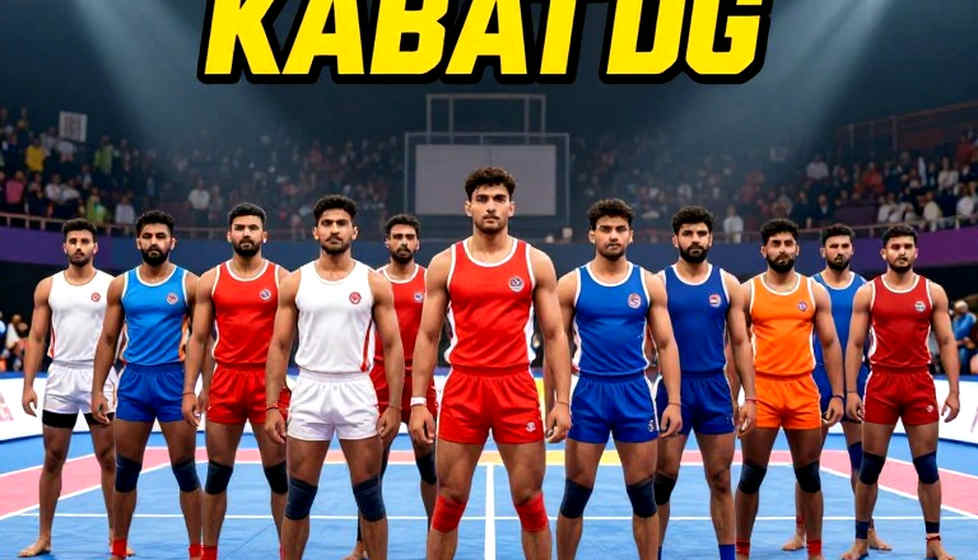
There is no performance data anywhere in the release — no raid points, no tackle efficiency, no full rosters. Yet the captaincy choices carry a professional imprint. Surjeet Singh is captain, Naveen Kumar vice-captain. On the domestic circuit Surjeet is a defender-profile name; Naveen is one of the most prolific raiders in Pro Kabaddi League history. India has therefore paired a defensive captain with an offensive vice-captain — one man owns the defensive line and the do-or-die decision-making, the other carries the scoring load. That is the standard high-performance template. The signal is clear: India is taking this seriously, not sending a B-side. In the women's squad Nidhi Sharma is captain and Ritu vice-captain, but with no stated roles or numbers, no assessment is possible.
The real story is hiding in the women's draw
This event's most important fact is the parallel women's competition — and the release itself did not treat it as important. The Pro Kabaddi League has no women's league. There is no professional women's kabaddi league anywhere in the world. That is precisely where the Olympic committee's biggest objection lives. A functioning women's draw at a Commonwealth championship is a direct answer to that objection. Twenty-three matches is a small number, but the direction is large.
And this is where the arithmetic bites. If the women's field is only six to eight nations, then the "13-country global championship" headline is doing work the women's draw cannot support. That is a structural weakness, and in Olympic terms it is the widest gap of all.
Brand assets exist, the market does not
Jersey, logo, mascot, anthem — all present. Broadcaster, prize purse, ticket pricing — all absent. The asset mix is not accidental. Jerseys, logos, mascots and anthems are what you produce when you are building a bid dossier and a press kit. Broadcast deals, prize money and ticketing are what you produce when you are building a commercial product. A 62-match event with no named broadcaster is, functionally, a tournament without an audience. The Pro Kabaddi League's entire success rests on television distribution. Without it, this event's reach is arena attendance plus whatever the federation posts itself.
Africa and the diaspora are two different models
The 13-nation list is genuinely broad by continent: four African, four Asian, two European, one North American, one Oceanian. For a first edition, that is an achievement and should not be dismissed. But diversity of flags is not diversity of competitive level. England, Scotland, Canada and Australia are sides built largely around South Asian diaspora communities — amateur squads following roughly the same mechanism that built cricket's associate nations. That is real growth, but it is diaspora growth, not indigenous growth.
Nigeria, Kenya, Tanzania and Uganda tell a different story. These are not diaspora organisations; they are attempts to enter a new market with federation support. For any Olympic argument, that is the actual asset, because the IOC does not count diaspora teams — it counts new countries. Four African nations are a more valuable signal than nine diaspora sides.
Data did not replace my eyes; it taught them where to look. Read six numbers together — 62, 39, 23, 13, 48 and zero broadcasters — and the picture resolves.
What is being misread
The biggest error here is not in the format. It is in the language. The organisers are talking about the Olympics, but the structure of this event argues the opposite. The Olympic criterion is global participation depth. A tournament that structurally excludes the world's second and third-ranked nations demonstrates Commonwealth depth, not global depth. Submit the wrong proof and the evaluator will not accept it — and then the failure narrative will feel like a surprise, even though the outcome was determined in advance.
A second misreading is the assumption that India's near-certain dominance makes the event analytically worthless. It does not. The value simply sits elsewhere. Who wins is not the question. The questions are whether the women's 23 matches were genuinely competitive, whether any development nation showed measurable improvement, and whether the event survived to a second edition.
A third misreading sits inside the organisation. The host federation, AKFI, has a documented history of election disputes and administrative paralysis, and periodically strained relations with the Indian Olympic Association and the Sports Ministry. For an event whose purpose is to impress an international evaluator, that operating entity is a credibility exposure. The Commonwealth Games Federation assesses institutional reliability, not just venue quality.
And one gap sits quietly unaddressed. A 400-athlete international championship with no stated anti-doping protocol, no refereeing standard, no video review and no appeal mechanism. Positive tests at domestic level are not new in kabaddi. This silence is not a formality gap. It is an institutional one.
The last word
What gets written in the notebook after the October 31 final is the real question. India will win both draws — that is not a prediction, it is close to a predetermined result. But the fate of this event depends on three things: whether the women's 23 matches actually happened on court, whether at least one of the four African nations showed measurable progress, and whether an announcement for edition two arrived before edition one ended. I learned to hear the game when the stands fell silent. This time the thing to listen to is what the 48-hour notice was saying.