
Fire in the Wall's Shadow: Anvay Dravid's 151 and the Limits of a Single Tournament
মূল উত্তর: অন্বয় দ্রাবিড়, ১৭ বছর বয়সী কর্ণাটকের উইকেটকিপার-ব্যাটার, বিনু মার্কার ট্রফি এলিট টুর্নামেন্টে ১০০ বলে ১৫১ রান করেন; কর্ণাটক ৩৫৮ রান তাড়া করে জেতে। এটি ঘরোয়া ৫০ ওভারের যুব প্রতিযোগিতা, International বা টি-টোয়েন্টি নয়। মূল তথ্য: • ১৫১ রান ১০০ বলে, ২৩টি বাউন্ডারি সহ, বিনু মার্কার ট্রফি এলিট টুর্নামেন্টে। • গুজরাট ৩৫৭, কর্ণাটক ৩৫৮ রান তাড়া করে জয়; তৃতীয় উইকেটে ২০৪ রানের জুটি। • অন্বয় ৪৪তম ওভারে আউট হন; এর আগে অনিকেত রেড্ডির সঙ্গে ৬১ রানের জুটি। • ৬৭ বলে ৮৭ রান এসেছে শ্রীলঙ্কা সফরে অনূর্ধ্ব-১৯ দলের সঙ্গে, আলাদা প্রতিযোগিতা। • অনূর্ধ্ব-১৯ অভিষেক গত বছরের নভেম্বরে; এই ম্যাচই প্রথম অধিনায়কত্ব। সূত্র: বিনু মার্কার ট্রফি এলিট টুর্নামেন্টের রিপোর্ট করা স্কোরকার্ড; প্রকাশের তারিখ উৎসে উল্লেখ নেই | Cross-checked: cricsultan.com সম্পর্কিত প্রশ্নোত্তর: প্রশ্ন: অন্বয় দ্রাবিড় কে? উত্তর: তিনি রাহুল দ্রাবিড়ের ছেলে এবং ১৭ বছর বয়সী কর্ণাটকের উইকেটকিপার-ব্যাটার। প্রশ্ন: ১৫১ রান কোন Formatে? উত্তর: ঘরোয়া ৫০ ওভারের বয়সভিত্তিক প্রতিযোগিতা, টি-টোয়েন্টি বা International নয়। প্রশ্ন: স্ট্রাইক রেট ১৫১ কেন অস্বাভাবিক? উত্তর: ৫০ ওভারে স্বাভাবিক ব্যান্ড ৭৫–৯৫, তাই এটি টি-টোয়েন্টি-সদৃশ টেম্পো।
In my London flat the rain taps the glass, the radiator gives off that dry winter smell, and a scorecard refreshes itself on the laptop. It is three in the morning. In Dhaka the clock is just short of eight. My body and my two cities have never agreed on time, and on nights like this the argument is settled the only way it ever is: I open the scorecard.
Anvay Dravid, 100 balls, 151 runs. Seventeen years old.
A domestic youth scoreline. Gujarat made 357; Karnataka were chasing 358. Inside that chase sat a third-wicket stand of 204, and at one end of it a seventeen-year-old wicketkeeper-batter who hit 23 boundaries and walked off in the 44th over with the foundation of the win already laid.
Before anything else, a boundary of definition. The 151 came in the Binu Markar Trophy Elite Tournament, a domestic 50-over age-group competition. It is not international cricket and it is not T20. The 87 off 67 came on a Sri Lanka tour with a U-19 side: a different competition, a different environment, a different ball. Fuse the two and the analysis thickens while the talent assessment goes wrong. For the son of a Dravid, that fusion is the easiest mistake available.
The profile is still small. Seventeen years old. Wicketkeeper-batter. U-19 debut last November. And this match was his first captaincy, ten months after that debut. He won the toss and chose to field, the modern limited-overs preference. Selectors do not hand a leadership badge to a teenager by accident; in age-group cricket, captaincy is usually a marker of trust.
Based on my years of watching matches, the normal strike-rate band in 50-over cricket sits between 75 and 95. A strike rate of 151 across 100 balls means a faster game has been imported into a slower format. I still keep one old commentary tape from 2026, the one where Rahul Dravid's cover drive is described in that unhurried voice; that tape is the single archive item I allow myself here, because the point is not nostalgia, it is contrast.
The innings was match-defining, not cosmetic. On a chase of 358, 151 runs from one batter is roughly 42 per cent of the target. He fell in the 44th over, by which time the base of the win existed. This is a high-leverage contribution, not a dead-rubber score.
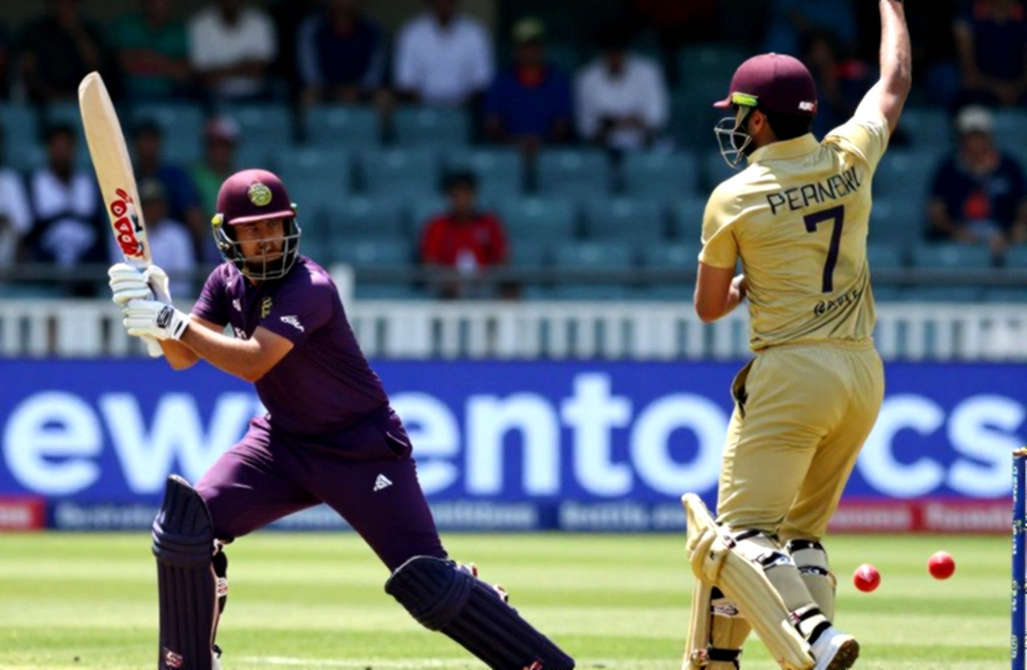
The strike rate of 151 is anomalous for the format, and that is the actual story. A T20 tempo is bleeding into the longer white-ball game, the way a young forward in football breaks the mould of the old centre-forward. The tape rewinds, and I hear old ghosts breathing between the frames, ghosts who taught that a bat meant a wall, patience, a block.
The 204-run third-wicket stand is the structural backbone. Two wickets had gone inside the first twelve overs; the partnership rebuilt the innings. That tells you Anvay was not a lone slogger but a partner in a stable stand, and he added a further 61 with Aniket Reddy. The 'pure destroyer' label sits in partial conflict with that fact, and the conflict is healthy.
Let me hold one moment, with no retrospective frame attached. The seamer hits a length, Anvay shifts his feet a fraction and sends the ball over cover; it rolls towards the rope and touches the boundary line. At the non-striker's end a teammate laughs, someone in the dugout shouts, and Anvay, reaching to fix the ear of his helmet, holds the bat up in a crooked, almost comic celebration. That is all. No meaning, just a good shot and a bad celebration.
Boundary dependence is high. Twenty-three boundaries in 151 runs; if all were fours, that is roughly 92 runs in boundaries alone, more than sixty per cent of the innings. It is a high-risk, high-reward model: runs come fast, but one bad delivery or one mistimed shot can break the rhythm.
Across three innings a pattern forms: 87 off 67 (a strike rate near 130), 85 off 41 (a strike rate of 207), and 151 off 100. Three different opponents, three different competitions, one register: attack. This is not an isolated explosion; it is a stylistic signature that keeps returning.
The structural scarcity of the wicketkeeper-batter slot adds a premium. A player who can keep wicket and bat at a strike rate near 150 occupies a genuinely scarce place in a modern squad, the wicketkeeper-batter premium. The flip side is physical: keeping is a load on a young body, and that risk belongs in the same ledger.
Anvay sits at the intersection of two pipelines: Karnataka's domestic system and India's U-19 structure. In Indian cricket this is the standard elite route. A captaincy debut ten months after a debut suggests gradual integration rather than a rushed elevation.
Now the hard part. The biggest risk is over-romanticisation, and I am the person most exposed to it. Three innings are not a career. His average, his modes of dismissal, his splits against pace and spin, none of it is in the source. Where there is no information, there should be no verdict. The word 'Destroyer' is a label generated by coverage, not an identity earned by a career; when the media coins a nickname for a boy, that is branding, not data.
The comparison needs the same care. The father's 'Wall' identity was built on Test-format endurance; the son's data comes from 50-over age-group cricket. Comparing a Test-defensive archetype with a white-ball-aggressive archetype is rhetorically powerful and analytically loose. After Russia 2026, I learned that renaissance is grief with better lighting; but between grief and renaissance there is a small boy who does not yet have a myth of his own.
Look at the rest of the scoreboard. Gujarat 357, Karnataka 358, both sides making almost identical totals, which points to a batting-friendly pitch, and on a batting-friendly pitch the frame of the extraordinary deserves a mild discount. Pitch, venue, required run rate: none of it is stated. The sourcing is unspecified, and the 357/358 and the Sri Lanka tour details need independent corroboration against a reported scorecard.
The largest human risk is expectation inflation. A seventeen-year-old will carry the shadow of 'the Wall's son' for the rest of his life, and every failed innings will lengthen that shadow. The historical hit rate of 'the next legend' labels in Indian cricket is low, which makes the nickname a potential liability rather than an asset. The nepotism debate will come too. The Dravid family has historically shielded its children from the media, and this volume of coverage may not even be the family's preference.
And I need to look at myself. Dhaka to London is my easiest metaphor. In this piece, Anvay will not be the instrument of that metaphor. In the ghost stadium, every empty seat asks who we become without a crowd; but this boy is not a mirror for my displacement. Before asking what the moment means about me, I should ask what he wanted, probably a fast run, a safe place, and a name of his own outside his father's.
The next season is the real trial. A full season of data will show whether the 151 was an event or the beginning of a habit. If a strike rate of 140 to 150 holds in 50-over cricket, a small but real bend will appear inside Indian batting culture. Until then, one frame stays filed: at three in the morning, in the sound of London rain, a scorecard recorded a seventeen-year-old wicketkeeper-batter at 151 off 100. Some rosters are elegies with jersey numbers, and I am their reluctant bard; here, there is no elegy, only a wait. Cricket's beauty is that at the end of every wait, another ball arrives.